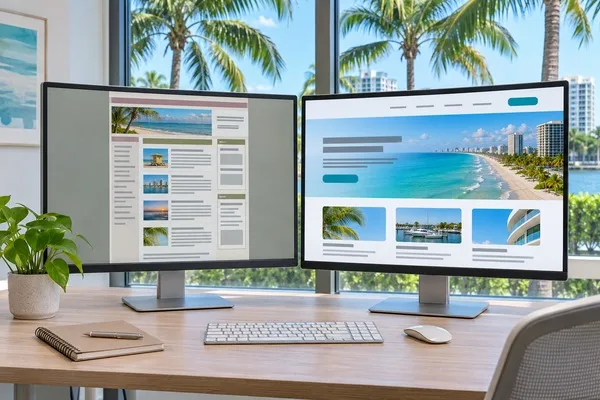
You must account for existing pages that attract visitors and host links as you get ready to launch a new website. Redirect every old URL, carry over the content and tags that already rank, build for speed and mobile, and watch Search Console closely after launch. Treat the redesign as an SEO website project from day one, and most of the horror stories never happen.
At REK Marketing and Design, we plan design and SEO together so a new site does not cost you the ground the old one earned. Planning a redesign? Reach out to our team or call (407) 500-0102 before you start.
Why Does Every Old URL Need a Redirect?
Because Google and your customers still know your old addresses. Without a permanent redirect, every old page that ranked or earned a link turns into a dead end.
Redesigns often change the URL structure. A page at one address moves to a new one, gets merged, or disappears. If nobody maps the old URLs to the new ones, visitors hit error pages, and the links other sites gave you stop pointing anywhere useful.
The fix is a page-by-page redirect map. Take a Fort Lauderdale HVAC company with years of service-area and repair pages. Each old URL should point to the closest matching new page, not just the homepage. According to Google's guidance on site moves, permanent redirects do not cause a loss in PageRank, so a good map carries your link value forward.
Google also notes that rankings can fluctuate while it recrawls a site after big changes. Clean redirects keep that period as short and steady as possible. Our web development process includes setting up redirects at launch.
How Should Content, Title Tags, and Internal Links Carry Over?
Keep what already ranks, and improve it rather than replace it. Content, title tags, and internal links that bring in traffic today are assets, not clutter.
Before anything gets rewritten, pull a list of the pages that earn clicks and the searches that bring them in. Those pages need their core content, their topic, and a title tag at least as strong as the one they have now. Cutting a ranking page to simplify the menu is one of the most common ways traffic disappears.
Picture a Boca Raton plumber whose water heater page ranks well. The new design can make that page faster and better looking, but the content that answers the question should stay. If you serve customers in both English and Spanish, keep both versions too.
Internal links matter as well. They tell Google which pages are most important and how they relate. A new navigation that drops links to key service pages can quietly weaken them. Our South Florida SEO work covers the tri-county area, from Miami-Dade to Palm Beach.
Why Do Site Speed and Mobile Layout Affect Rankings?
Because most local searches happen on a phone, and people leave slow pages. Google pays attention to the experience your site gives those visitors.
A redesign is the perfect moment to fix speed. Heavy images, bloated templates, and layers of plugins slow a site down, especially on a cell connection. When someone in Doral searches for an electrician from their phone, they will tap the next result before a slow page finishes loading.
Mobile layout counts just as much. Tap targets need room, text needs to be readable without zooming, and the phone number should be easy to call. Every site we build is custom-coded in HTML5, CSS3, and JavaScript, designed mobile-first, and then scaled up to desktop.
The key is that these choices get made during design, not after launch. Speed and layout are much harder to fix once the site is live.
What Should You Watch in Search Console After Your SEO Website Launches?
Watch for errors, indexing changes, and drops in clicks on your most important pages. The first few weeks after launch are when problems are easiest to catch and fix.
Check the Pages report for new "not found" errors, which usually mean a missing redirect. Submit the new sitemap and track how many pages get indexed. Compare clicks and impressions for your top pages before and after launch, and look into any big drops right away.
This is also where design and SEO decided separately shows its cost. When a designer launches a site and an SEO team is called in later, the redirects, content, and tags are often already lost. Planning both together from the start is how you avoid it. We cannot promise rankings to anyone, but we can make sure the launch does not throw away what you have built.
Before your redesign starts, get a clear picture of what is working now. Request a free SEO audit, or contact our team at (407) 500-0102 to plan your redesign as an SEO website project.